Fiber vs. Wireless Broadband: Which One Actually Works for Your Hyderabad Home? (2026)
Last Updated: June 2026
If you’ve just moved into a new place in Hyderabad, you’ve probably faced a frustrating choice. You call a provider, and they tell you that Fiber installation will take a week because they need to run a cable from the street. Then, they offer you a “Wireless Home WiFi” or “AirFiber” device that you can plug in and use today.
It sounds like a dream: No drilling, no wires, and instant internet. But is it a shortcut to a bad experience?
In a city like Hyderabad, where reinforced concrete walls are the norm and peak-hour congestion is a daily reality, the difference between a physical fiber cable and a wireless signal is massive. One is a dedicated lane for your data; the other is a shared radio wave fighting for space in the air.
This guide strips away the marketing jargon and tells you exactly which technology you should choose based on where you live and what you actually do online.
⚡ The “Quick-Decision” Matrix
Don’t waste hours researching. Find your profile below and get the answer immediately:
| If you are a… | Best Choice | The “Why” |
| Hardcore Gamer / Day Trader | Fiber (FTTH) | Lowest possible “Ping” (Latency) is mandatory. |
| WFH Professional | Fiber (FTTH) | Symmetrical upload speeds for stable Zoom/Teams calls. |
| Student in a PG / Short-term Rental | Wireless/5G | Zero installation hassle and easy to move. |
| Living in a Peripheral Layout | Wireless / AirFiber | Use this if fiber “feasibility” fails at your address. |
| Casual Browser / Netflix User | Either | For basic streaming, both work fine. |
🛠️ The “Real-World” Difference: Light vs. Radio
To understand why one is better than the other, you have to understand how the data actually reaches your router.
Fiber Broadband (The “Dedicated Pipe”)
Fiber uses pulses of light sent through strands of glass. Think of this as a private, underground tunnel dedicated to your data.
The Hyderabad Reality: In areas like HITEC City, Gachibowli, and Madhapur, fiber is the backbone. Because it’s a physical cable, it doesn’t care if your neighbor has a powerful router or if there are 50 other networks in your building. The signal is “locked in.”
The Result: Rock-solid stability and speeds that don’t dip when the rest of the colony logs on at 8 PM.
Wireless Broadband (The “Shared Air”)
Wireless (including 4G/5G Home WiFi and AirFiber) uses radio waves beamed from a tower to your home. Think of this as shouting a message across a crowded room.
The Hyderabad Reality: Radio waves are affected by everything. A new building coming up next door, a thick concrete wall, or even heavy monsoon rain can “block” or weaken your signal.
The Result: Your speed might be 100 Mbps at 11 AM, but it could drop to 20 Mbps at 9 PM because the cell tower is overwhelmed by thousands of smartphones in your area.
🥊 Head-to-Head: The “Pain Point” Comparison
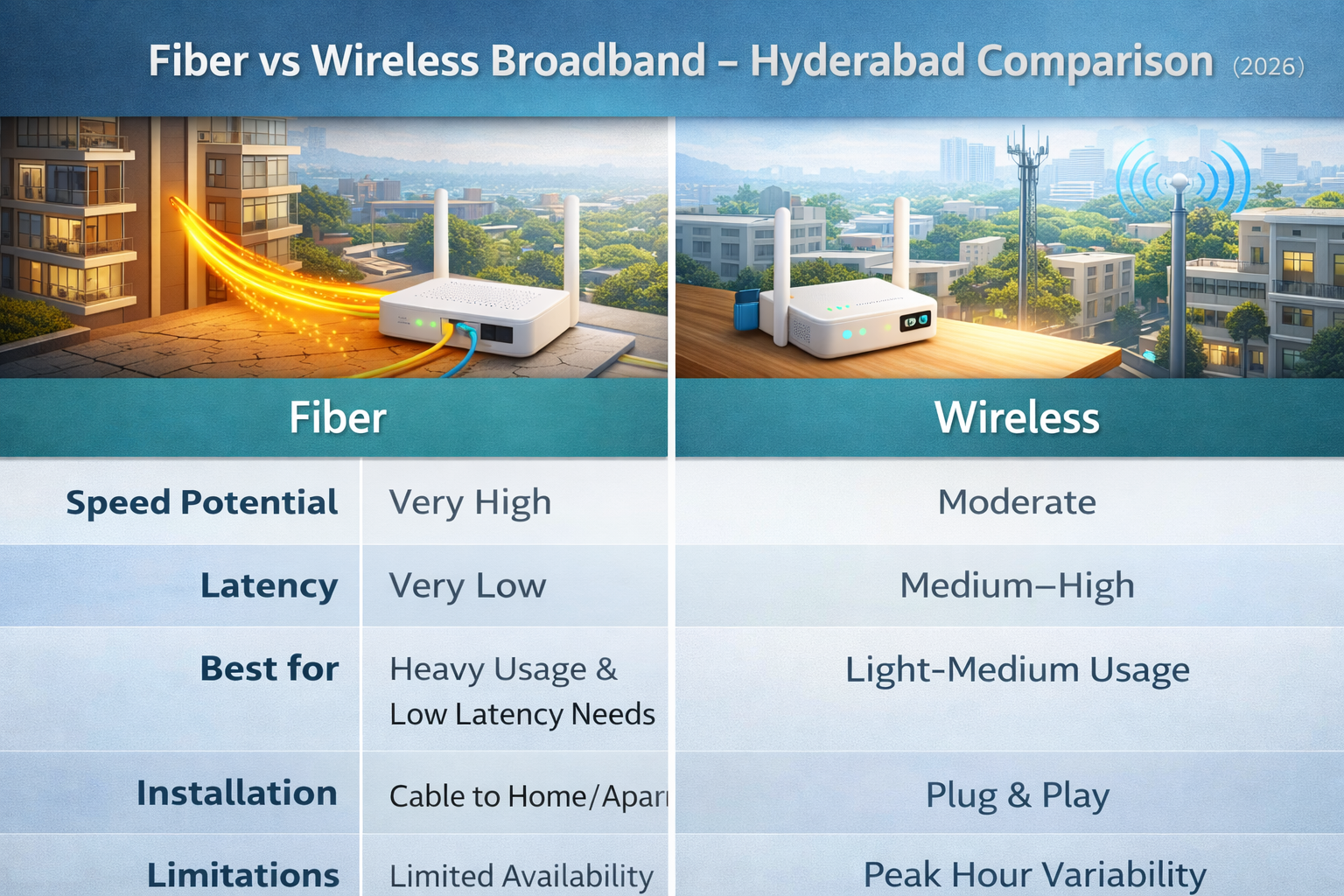
| The Problem | Fiber (FTTH) | Wireless / AirFiber | Who Wins? |
| Peak Hour Lag | Almost None. Stable speeds. | High. Speeds dip during congestion. | Fiber 🏆 |
| Installation | Slow (1-7 days, needs wiring). | Instant (Plug & Play). | Wireless 🏆 |
| Upload Speed | High & Symmetric (Fast uploads). | Low (Slow uploads). | Fiber 🏆 |
| Stability | Immune to weather/walls. | Affected by rain and obstacles. | Fiber 🏆 |
| Cost of Entry | Higher setup fee. | Lower / No setup fee. | Wireless 🏆 |
📉 The “Upload Trap”: Why it Matters for WFH and Students
Most people only look at Download speed. But in 2026, Upload speed is where the real battle is won.
If you are a student in Ameerpet submitting a large assignment or a professional in Manikonda sharing your screen on a Microsoft Teams call, you are uploading data.
Wireless Limitation: Wireless connections are often “asymmetric.” You might have a fast download, but a tiny upload. This is why your voice “breaks” or your video freezes, even though your speed test says “100 Mbps.”
Fiber Advantage: Fiber offers symmetric or near-symmetric speeds. If you have a 100 Mbps plan, your upload is usually close to 100 Mbps. This makes your video calls crystal clear and your cloud backups instant.
⛈️ The “Hyderabad Monsoon” Effect
Living in Hyderabad, we have to talk about the weather.
Fiber is buried underground or run in protected conduits. It doesn’t care if there is a thunderstorm in Uppal or heavy rain in Secunderabad. Your internet stays exactly the same.
Wireless/AirFiber relies on “Line of Sight.” Heavy rain and thick clouds can cause “Signal Attenuation.” This means the radio waves are absorbed by the rain, leading to sudden speed drops or intermittent disconnections. If your work is mission-critical, relying on a wireless signal during a Hyderabad monsoon is a risky game.
📍 Area-Specific Advice: What Should You Choose?
1. The IT Corridors (HITEC City, Gachibowli, Madhapur)
In these areas, fiber infrastructure is mature and highly competitive. There is zero reason to choose wireless here. Fiber is available, stable, and fast. If a salesman tries to sell you a wireless “AirFiber” device in these areas, they are likely doing it because it’s easier for them to install, not because it’s better for you.
2. Established Residential Areas (Kukatpally, Miyapur, LB Nagar)
Fiber is available in most apartments, but in independent houses, it can be a struggle. If you are in a house and the ISP says “No Feasibility” for fiber, Fixed Wireless (with a rooftop antenna) is a great middle-ground. It’s more stable than a 5G router but easier to install than fiber.
3. The Peripheral Layouts (Outskirts, New Layouts)
In the developing edges of the city, fiber hasn’t reached every street yet. In this case, 5G Home Broadband is a fantastic temporary solution. It gets you online instantly while you wait for the fiber cables to be laid in your colony.
❓ Frequently Asked Questions
Q: I keep seeing "AirFiber" advertised. Is that the same as a Fiber connection?
A: No, and this is where many people get confused. “Fiber” (FTTH) means a physical glass cable comes directly into your home. “AirFiber” is actually a wireless signal beamed from a tower to an antenna on your roof. While AirFiber is faster to install, it can never match the rock-solid stability and low latency of a physical fiber cable. If you have the choice, always go for the physical fiber.
Q: Will the heavy Hyderabad monsoon rains affect my wireless broadband?
A: Yes, they can. Radio waves used by wireless broadband are susceptible to “rain fade” (signal attenuation). During a heavy downpour in areas like Uppal or Secunderabad, you might notice your speeds dropping or your connection becoming unstable. Fiber, because it is buried underground or in protected conduits, is completely immune to the weather.
Q: I’m a student in a PG for 6 months. Should I still wait for a fiber installation?
A: In your case, probably not. Fiber installation can be a hassle and often requires a long-term commitment or a high setup fee. For a short-term stay in a PG, a 5G Home Router or Wireless connection is the smarter choice. It’s plug-and-play, requires no drilling in your landlord’s walls, and you can simply take it with you when you move.
📚 Check our guides if you want know other details?
Now that you know if it’s available, figure out which one to pick:
🏁 Final Verdict: The “Decision Tree”
Go with Fiber (FTTH) IF:
You work from home or attend online classes.
You are a gamer (you need that low ping!).
You have a family with 3+ devices streaming at once.
You plan to live at the address for more than 6 months.
Fiber is available at your address.
Go with Wireless / AirFiber IF:
Fiber is physically unavailable (No feasibility).
You are a student in a PG or a short-term rental.
You only use the internet for basic browsing and social media.
You need internet today and cannot wait for a technician.
The Bottom Line: Wireless is a great bridge, but Fiber is the destination. If you have the option, always choose the wire. It is the only way to ensure that the speed you pay for is the speed you actually get.
Disclaimer: This guide is for informational purposes. Actual performance depends on your specific location, building construction, and the ISP’s local node congestion. Always verify availability before signing a contract.